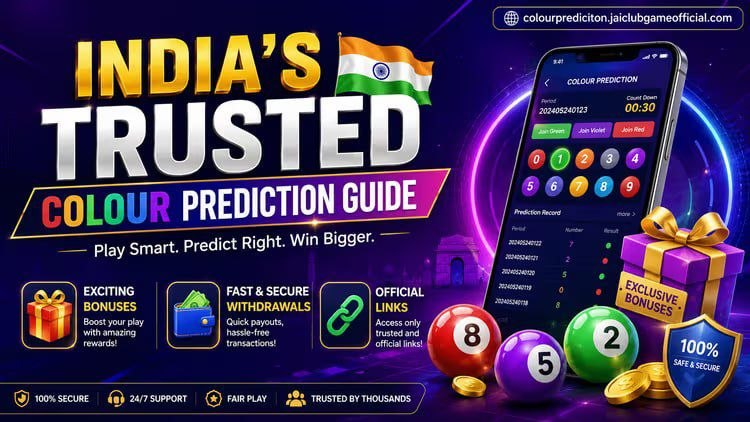

Walk into any serious colour prediction player’s routine and you will likely find a round history tab open or a notebook tracking results. These players are not guessing blindly. They are using prediction charts — visual logs of past round outcomes — to structure their decisions.
Whether charts reliably indicate future outcomes is a debate worth having. What is not debatable is that systematic players who track results make more deliberate bets than those who react emotionally. This guide explains what a prediction chart shows, how to read it, and how to use it without falling into the trap of seeing patterns that do not exist.
What a Colour Prediction Chart Is
A prediction chart is a chronological log of colour outcomes across past rounds. Each round results in red, green, or violet. A chart maps these results visually — coloured blocks or icons in sequence — letting you scan for patterns at a glance.
The in-app history feature on platforms like Jalwa, Jai Club, and OkWin serves as a built-in prediction chart. Most let you scroll back through the last 50 to 200 rounds. Third-party Telegram groups and standalone tools compile this data into more elaborate charts with streak counters and frequency breakdowns.
Advanced charts track number-colour correlations in Wingo (where each number maps to a colour), big/small outcomes alongside colour results, and period-by-period frequency breakdowns across hundreds of rounds.
How to Read a Prediction Chart Step by Step
Start with the last 20 rounds. Count how many times each colour appeared. A typical fair distribution sits around 40% red, 40% green, and 10–15% violet. Significant imbalances — say 15 consecutive reds — mark streaks worth noting.
Streaks are the most commonly tracked pattern. A run of the same colour does not guarantee continuation, but many players use it as a signal to either ride the direction or wait for reversal.
Alternating patterns — RGRGRG or similar — appear periodically and prompt some players to bet against the sequence. Others track violet gap lengths: since violet is rare, unusually long gaps between violet appearances prompt some players to increase violet probability weighting.
What a chart cannot do is give certainty. Each round is statistically independent. Past results do not cause future ones. The chart is a tool for pattern awareness, not a guaranteed predictor.
Community pattern analysis across round histories is shared regularly in forums on colour prediction — useful for cross-referencing your own observations against how other experienced players are reading the same data.
Common Chart Analysis Approaches
Different players use prediction charts differently. The most common approaches:
- Streak following — bet in the same direction as an active streak, exiting after 3–4 consecutive correct calls
- Streak fading — bet against a long streak expecting reversion after 5+ same-colour consecutive results
- Gap analysis — track rounds between violet appearances; bet violet when the current gap exceeds historical average
- Frequency balancing — over 100 rounds, bet the underrepresented colour until the distribution normalises
- Number-colour mapping in Wingo — bet on specific numbers tied to preferred colours rather than betting colour directly
No approach guarantees results. Each shows periods of positive and negative performance consistent with random outcomes. Players who stick to one approach consistently and manage their bankroll accordingly tend to have more stable long-term results than those who switch methods every few rounds.
The Limits of Chart Analysis
The most important thing to understand about prediction charts is that outcomes are generated by algorithms or blockchain data designed for fairness, not predictability. Charts show what happened — not what will happen.
Pattern-seeking bias is the primary risk. The human brain finds patterns in random data. A chart showing 5 consecutive reds feels like evidence red is “hot” — statistically it is not. Use charts to discipline decision-making rather than override it. Decide your strategy before opening the chart, apply it for a defined set of rounds, and evaluate over that whole window rather than after each individual result.
Frequently Asked Questions
Are prediction charts available inside colour prediction apps?
Yes. Most major platforms including Jalwa, Jai Club, and OkWin display a round history log that functions as a prediction chart. You can view the last 50–200 rounds within the app. Some platforms offer graphical trend displays or streak counters that make pattern identification faster without manual counting. The in-app chart is always the most reliable primary source.
How many rounds of history should you analyse before betting?
Most experienced players analyse a minimum of 20–30 recent rounds before starting a session. This gives enough data to spot active streaks and frequency imbalances. Fewer than 20 rounds is too small a sample. More than 100 rounds can obscure recent patterns with older data — what happened 200 rounds ago may not reflect current platform dynamics at all.
Do prediction charts work on TRX hash-based variants?
TRX hash games derive results from blockchain transaction data, considered more genuinely random than standard PRNG outputs. Charts still display historical results and streak analysis remains applicable, but the blockchain basis makes results harder to pattern-match than standard Wingo rounds. Any Telegram tool claiming to predict TRX hash results in advance is fraudulent — future blockchain hashes are unknown until they occur.
Can a prediction chart tell you when violet will appear next?
No chart predicts violet with certainty. Gap analysis shows whether the current gap between violet appearances exceeds historical averages, which some players interpret as increased short-term probability. The logic has statistical grounding but is not a guarantee — violet can and does extend beyond average gaps occasionally. Use it as one signal among several rather than the sole basis for a bet.
Are third-party prediction chart tools reliable?
Third-party tools vary in quality and can have data delays or errors. Always cross-reference any third-party chart against your platform’s own round history before acting on it. Playing on incorrect historical data due to a third-party tool error has cost players money before. The in-app history is authoritative — everything else is supplementary.
Conclusion
A prediction chart is one of the most valuable free tools a colour prediction player has — when used correctly. It builds pattern awareness, reduces emotional decisions, and helps you apply strategies consistently rather than chasing each result as it comes. Pair chart analysis with solid bankroll management and you have a framework that most casual players lack. For platforms with strong in-app history features and transparent round data, explore the reviews at colour prediction and choose an app where the data works for you.