
Introduction
Growth is the goal of virtually every business, but not all growth strategies are created equal. Some drive rapid but unsustainable expansion; others build the kind of steady, compounding growth that creates enduring value. Understanding which growth strategies are most appropriate for your business — based on your stage, resources, market, and risk tolerance — is one of the most important strategic decisions you will make. This article explores the most effective business growth strategies and how they can be applied in competitive markets like Hong Kong.
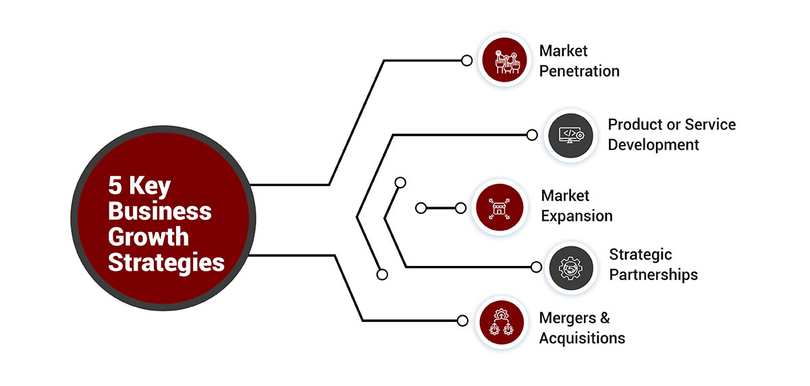
Market Penetration
Market penetration is the most straightforward growth strategy — selling more of your existing product to your existing market. This can be achieved through competitive pricing, increased marketing investment, improved distribution, or enhanced customer retention efforts. It is generally the lowest-risk growth strategy because you are operating in familiar territory with a product you already understand.
For businesses that have set up a company in Hong Kong and are building their local presence, market penetration is often the first priority. Hong Kong’s dense, affluent consumer base provides significant opportunity to deepen market share before expanding regionally. Focus on understanding what drives customer loyalty and satisfaction, and invest in initiatives that strengthen those drivers.
Market Development
Market development involves taking your existing product into new markets — whether new geographic regions, new customer segments, or new distribution channels. For Hong Kong-based businesses, this often means expanding into mainland China, Southeast Asia, or other international markets.
This strategy requires careful analysis of the target market’s competitive dynamics, regulatory environment, customer behaviour, and cultural nuances. Hong Kong’s international connectivity — including its role as China’s primary offshore financial centre and its participation in the Greater Bay Area development — makes it an exceptional platform for regional market development.
Product Development
Product development — creating new offerings for your existing customers — leverages the relationships and trust you have already built to generate additional revenue. This strategy is particularly effective when you have deep customer insight that enables you to identify unmet needs and create solutions that your competitors cannot easily replicate.
The key to successful product development is a disciplined innovation process: identify genuine customer problems, prototype solutions quickly, test with real customers, and iterate rapidly. Avoid the trap of building features or products that seem interesting internally but do not address meaningful customer needs.
Diversification
Diversification — entering new markets with new products — is the highest-risk growth strategy. It requires you to build new capabilities, understand unfamiliar markets, and compete without the advantages of established relationships or institutional knowledge. However, when executed well, diversification can dramatically expand your total addressable market and reduce business risk by spreading revenue across multiple streams.
Related diversification — moving into areas that leverage your existing competencies — is far safer than unrelated diversification. If you are a technology company expanding into a new vertical, for example, you can apply your technical capabilities while learning a new market. Unrelated diversification requires starting almost from scratch and is generally only appropriate for very well-capitalised businesses.
Strategic Partnerships and Alliances
Sometimes the fastest path to growth is not organic but through partnership. Strategic alliances, joint ventures, and distribution partnerships allow businesses to access new markets, capabilities, and customer bases without the full cost and risk of building these independently. In Hong Kong, where relationships and networks are critical to business success, cultivating strategic partnerships is both a cultural expectation and a powerful growth driver.
Identify partners who serve the same customers you do but do not directly compete with you. Structure partnerships around clear mutual value exchange, with well-defined roles, responsibilities, and performance expectations. Treat your partners as extensions of your own business, with the respect and communication that relationship deserves.
Digital Growth Channels
In today’s digital environment, businesses that master digital growth channels can scale faster and more cost-effectively than those relying on traditional methods alone. Search engine optimisation, content marketing, social media, email marketing, paid digital advertising, and referral programmes are all powerful tools for driving growth at scale.
Hong Kong’s high internet penetration and mobile-first consumer culture make digital channels particularly effective. However, succeeding in digital requires not just investment in tools and platforms but a commitment to creating genuine value through high-quality content, personalised communications, and outstanding digital customer experiences.
Acquisition
For well-capitalised businesses ready for accelerated growth, acquiring competitors or complementary businesses can be a highly effective strategy. Acquisitions provide immediate access to customers, talent, technology, and market presence that would take years to build organically. Hong Kong’s active M&A market and its role as a regional financial centre make it an excellent base for businesses pursuing an acquisition-led growth strategy.
Successful acquisitions require rigorous due diligence, realistic integration planning, and careful cultural alignment. The majority of acquisitions fail to create value because the acquirer underestimates integration complexity and overestimates synergies. Approach acquisitions with realistic expectations and detailed post-merger integration plans.
Conclusion
There is no single growth strategy that works for every business at every stage. The most effective approach combines multiple strategies, sequenced and balanced according to your specific circumstances. What matters most is the discipline to understand your market deeply, the clarity to choose your growth priorities deliberately, and the execution capability to deliver consistently. For businesses that set up a company in Hong Kong, the city’s strategic position, exceptional infrastructure, and dynamic business ecosystem provide a powerful foundation for executing virtually any growth strategy.
Frequently Asked Questions (FAQs)
Q: What is the most effective business growth strategy?
A: The most effective strategy depends on your business stage and context. Market penetration is usually lowest risk; market development offers significant upside for Hong Kong-based businesses given the region’s growth. Product development and strategic partnerships often provide the best risk-return profile for mid-stage companies.
Q: How can Hong Kong businesses expand into mainland China?
A: Hong Kong businesses can leverage the city’s CEPA agreement with mainland China, which provides preferential access for Hong Kong companies in certain sectors. The Greater Bay Area initiative also offers specific opportunities for cross-border expansion.
Q: When should a business consider acquisition as a growth strategy?
A: Acquisition makes sense when organic growth is too slow, when a target offers capabilities or markets that are difficult to build internally, and when you have the financial capacity and management bandwidth to execute a successful integration.
Q: What digital growth channels work best in Hong Kong?
A: Social media platforms like WeChat, LinkedIn, Instagram, and Facebook are widely used. Search engine marketing and content marketing are effective for B2B companies. Mobile-first experiences and e-commerce are particularly important given Hong Kong’s high smartphone penetration.
Q: How do I choose the right growth strategy for my business?
A: Start by assessing your current strengths, the size of your existing market opportunity, and your available capital and capabilities. Match your strategy to your stage: early-stage businesses should focus on market penetration; growth-stage businesses can pursue market development and product development; mature businesses may consider acquisitions or diversification.